

Winter maintenance in a Toronto home comes down to a few habits: keep the heating system running well, make sure your smoke and carbon monoxide alarms work, protect your pipes, control indoor humidity, test your sump pump, and keep snow and ice away from the foundation and roof. Spread over December, January and February, it takes less than an hour a month.
Most of the expensive winter repairs I see could have been avoided with a few minutes of checking. This is the checklist I give clients after we finish a renovation, so the work we did stays in good shape.
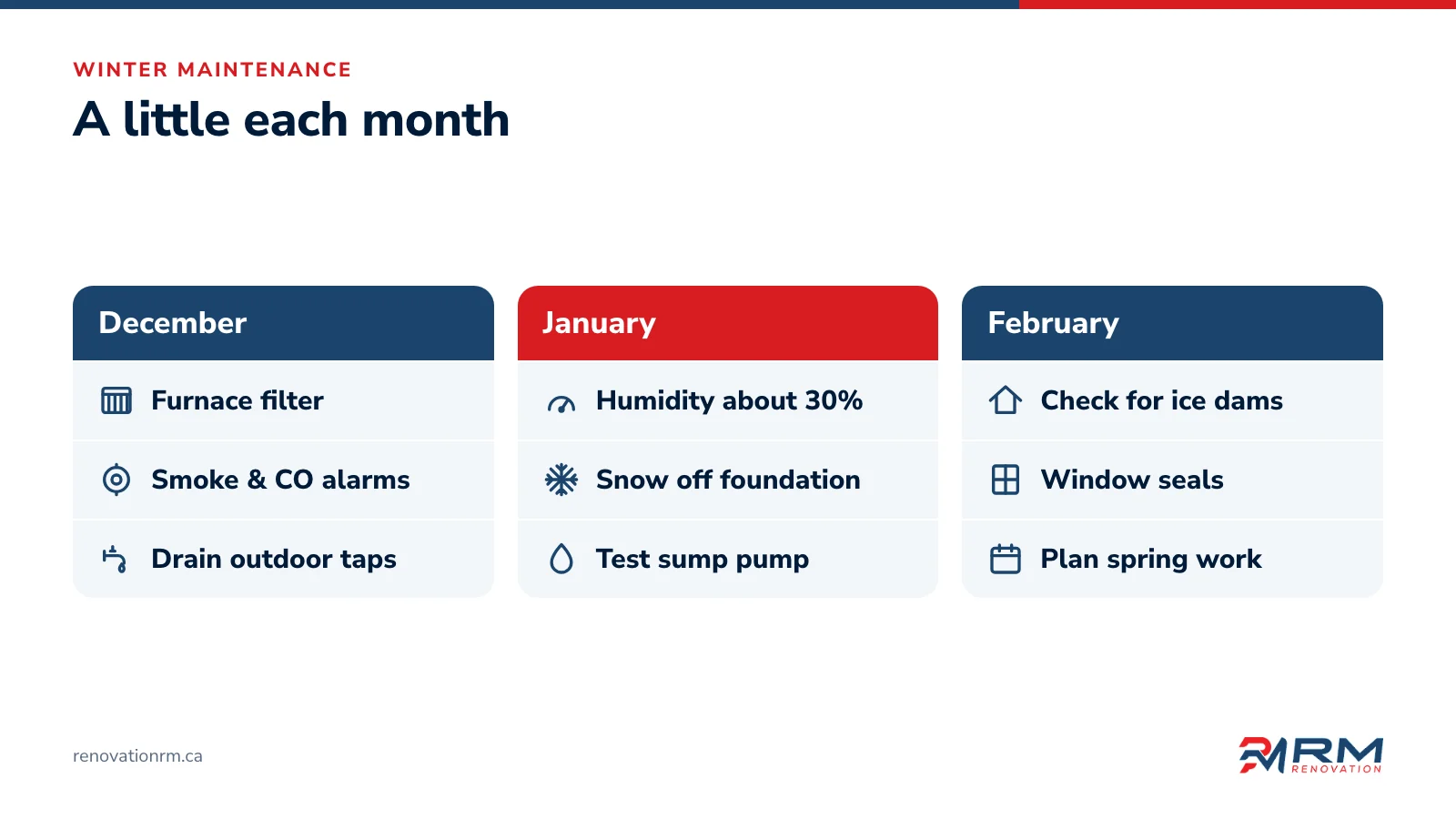
December: Get the House Ready
- Change the furnace filter. A clogged filter makes the furnace work harder. Most need changing every one to three months in winter.
- Test smoke and carbon monoxide alarms. Ontario requires a working smoke alarm on every storey and outside sleeping areas. Since January 1, 2026, homes with a fuel-burning appliance, fireplace or attached garage also need a carbon monoxide alarm on every storey and next to sleeping areas. Details are on the Ontario carbon monoxide safety page.
- Shut off and drain outdoor faucets. See how to drain an outdoor faucet for winter.
- Find your main water shut-off and make sure it turns freely.
January: Watch the Cold Snaps
- Keep an eye on humidity. In very cold weather, aim for about 30% indoors. Water running down your windows means it is too high, which I explain in how to stop condensation on windows in winter.
- Protect pipes on exterior walls when nights drop below minus 10°C. My full guide is frozen pipes in Toronto homes.
- Test the sump pump by pouring a bucket of water into the pit. Melting snow during a January thaw can fill it quickly.
- Keep snow away from the foundation, window wells and the gas meter, and clear the furnace and water heater vents on the outside wall.
February: Look Up and Plan Ahead
- Check for ice dams along the edge of the roof. Large icicles and ice build-up often mean warm air is escaping into the attic.
- Look for drafts and failing window seals. Fogging between panes means the seal has failed.
- Check the attic hatch for frost on the underside of the roof, a sign of air leaks.
- Plan your spring projects now, so permits and materials are ready when the weather turns.
When Maintenance Turns Into a Renovation
Some problems keep coming back no matter how careful you are: a pipe that freezes every year, ice dams over the same room, a basement that is always cold. Those are signs the house needs more than maintenance. Air sealing, insulation and moving pipes are much easier during a renovation, which is why I wrote winter-proofing an older Toronto home. We handle this work through our whole-home renovation services in Toronto and across the GTA, including home renovations in Vaughan and home renovations in Oakville.
Need a Hand This Winter?
If something on this list turns up a bigger problem, we are here all winter. Read our Google reviews for RM Renovation and book a free consultation.
Frequently Asked Questions
How often should I change my furnace filter in winter?
Check it monthly and change it every one to three months, depending on the filter and whether you have pets or renovation dust in the house.
Do I need a carbon monoxide alarm on every floor in Ontario?
Yes, if your home has a fuel-burning appliance, a fireplace or an attached garage. Since January 1, 2026, the Fire Code requires one on every storey and next to sleeping areas.
What indoor humidity is right in winter?
About 30% in very cold weather and up to about 40% on milder days. If windows are wet every morning, it is too high.
What causes ice dams on a roof?
Warm air leaking into the attic melts snow on the roof, and the water refreezes at the cold edge. Air sealing and insulating the attic is the lasting fix.
Written by Robert Milchevich, RM Renovation.