
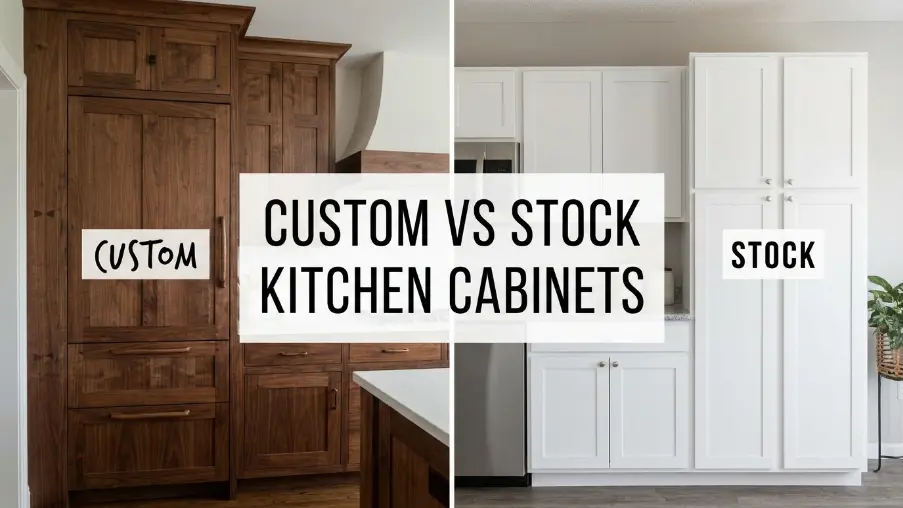
Custom cabinets fit your exact space and can last for decades, while stock cabinets cost far less and install quickly. The right choice usually comes down to three things: your budget, your timeline, and how your kitchen is built.
After more than a decade of fitting cabinets into homes across the GTA, one pattern stands out. Many local homes are older, so walls aren’t perfectly straight and ceilings often vary by an inch or two. That small detail changes the decision more than most homeowners expect.
In this guide, you’ll see the real costs, practical trade-offs, and which option makes the most sense for your kitchen and long-term plans.
Custom vs Stock Kitchen Cabinets: Quick Comparison
The table below compares the two options on the five factors that decide most kitchens: price, fit, speed, materials, and best use.
| Factor | Stock Cabinets | Custom Cabinets |
| Cost (per linear foot) | $150 to $400 | $700 to $1,200+ |
| Fit | Standard sizes; gaps covered by filler panels | Scribed to your exact walls |
| Lead time | A few days to 3 weeks | 8 to 16+ weeks, plus design time |
| Box material | Often MDF or particleboard | Plywood, with solid wood fronts |
| Best suited to | Tight budgets and square rooms | Tricky spaces and long-term homes |
What Are Custom Cabinets?
Custom cabinets are units built to order for one specific kitchen. A cabinetmaker measures the room first, then crafts every box, door, and drawer to those exact dimensions. Nothing arrives pre-sized.
Each piece is made from scratch, so custom cabinets carry features that off-the-shelf units rarely match. The boxes use furniture-grade plywood, and the fronts come in solid wood or quality veneer. Soft-close hinges, dovetailed drawers, and ceiling-height uppers are standard at this tier.
You also choose the wood species, the finish, and the hardware. That control turns awkward corners into usable storage, which is why most of our custom kitchen renovation projects start with full measurements.
What Are Stock Cabinets?
Stock cabinets are pre-built units sold in fixed sizes and finishes. You buy them off the shelf at big-box stores or order ready-to-assemble kits, so they ship fast and cost the least.
Their main feature is standardization. Widths typically increase in 3-inch steps, often ranging from about 9 to 48 inches. Because of this fixed sizing, the cabinets rarely match wall dimensions perfectly, so installers often use filler strips to close gaps.
Design options are also limited. Most stock lines focus on a few popular styles like shaker or slab, with a small selection of colors and finishes. On the material side, many budget-friendly options use MDF or particleboard cores wrapped in melamine, rather than solid plywood.
Custom vs Stock Cabinets: Head-to-Head Comparison
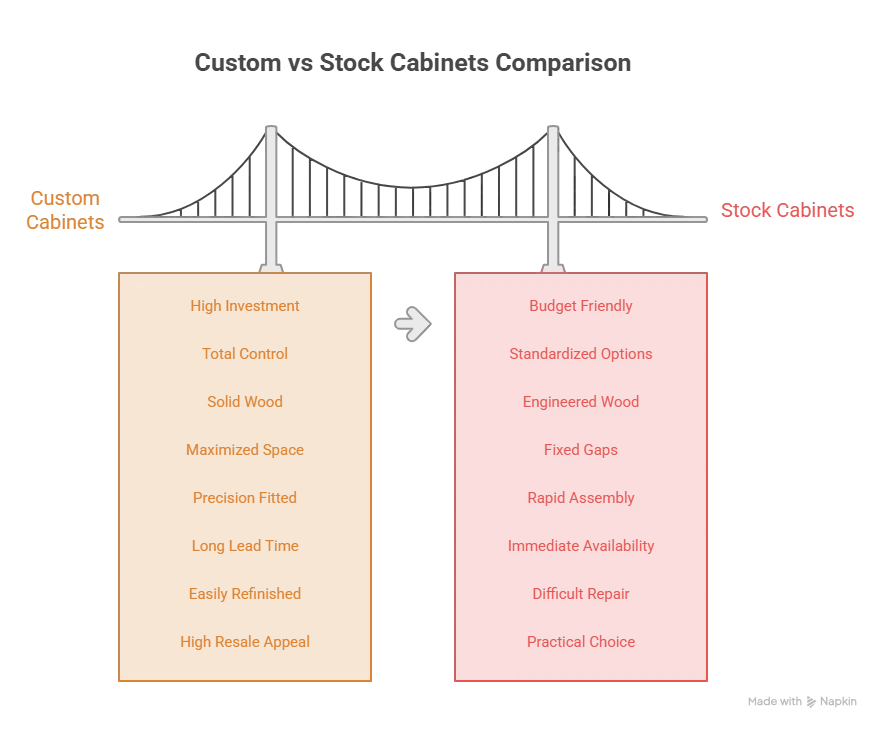
Now let us put the two side by side. Each factor below shows what custom delivers, then what stock delivers, so you can measure both against your goals.
1. Cost Comparison (Upfront and Total Project Cost)
Custom: Custom runs roughly $700 to $1,200 per linear foot installed, more for premium millwork. A standard 10×10 kitchen lands between $15,000 and $40,000 for the cabinets alone.
Stock: Stock sits far lower, at about $150 to $400 per linear foot. The same 10×10 kitchen often stays near $4,000 to $8,000 for materials before installation. Moving plumbing or electrical adds cost to either choice.
2. Design Flexibility and Customization Options
Custom: Custom gives near-total control over species, finish, door profile, and internal layout. As a result, it suits a century-old home or a glass-walled condo with equal ease.
Stock: By contrast, stock limits you to set sizes and a short style menu. You shape the kitchen around the cabinets, not the reverse, which works best in rectangular rooms.
3. Material Quality and Durability Differences
Custom: Plywood boxes and solid wood fronts give custom cabinets 20 to 30 years of service with normal care. Plywood also holds screws and hinges tightly, so doors stay aligned through daily use.
Stock: Budget stock relies on MDF or particleboard, which swells once moisture reaches it near a sink or dishwasher. For how these materials behave under humidity, the U.S. Forest Products Laboratory publishes detailed research on engineered wood.
4. Storage Efficiency and Space Optimization
Custom: Custom uses every inch. Built-in organizers, pull-outs, and full-height uppers turn dead corners into working storage, which pays off in compact condo and bungalow kitchens.
Stock: Stock, meanwhile, leaves gaps that filler panels cover but cannot use. Fixed depths also strand vertical space near the ceiling. A sharp layout recovers some of it, though a portion is lost.
Read More: Small Condo Renovation Ideas: Smart Upgrades to Maximize Space
5. Installation Time and Project Timeline
Custom: Custom cabinets take more time to install because each piece is carefully fitted to the walls and adjusted for uneven floors. The extra work creates a clean, built-in look with no visible gaps, fillers, or shims.
Stock: Stock cabinets install faster because the cabinet boxes come in standard sizes. In a straight, square kitchen, installation can often be finished in a day or two. If the walls or floors are uneven, installers may need extra fillers and adjustments to achieve a clean fit.
6. Availability and Lead Time
Custom: Custom cabinets typically take 8–16 weeks or longer to manufacture, plus additional time for design, approvals, and measurements. If you’re planning a renovation during busy seasons, it’s wise to order early since contractors and installers often book months in advance.
Stock: Stock cabinets are usually available within a few days to a few weeks. If you’re working with a tight schedule, such as an upcoming move, home sale, or growing family, the faster turnaround can be a major advantage.
7. Maintenance and Repair Considerations
Custom: Custom cabinets are often easier to repair because solid wood can be sanded, refinished, or touched up when it gets scratched or dented. Minor damage usually doesn’t require replacing the entire door, helping the cabinets maintain their appearance for many years.
Stock: Stock cabinets can be more difficult to repair, especially if the veneer or laminate starts to peel or chip. High-use areas, such as trash pull-outs and under-sink cabinets, tend to wear out first. If replacement parts are needed years later, finding an exact match may not always be easy.
8. Return on Investment (Home Value Impact)
Custom: Buyers notice a well-built kitchen, so quality cabinetry lifts resale appeal. In a competitive GTA market, that polish helps a home stand out and sell faster. A kitchen upgrade often pairs well with a whole home renovation when you are prepping to sell.
Stock: Stock cabinets are often the more practical choice for rental properties, house flips, or homeowners planning to move soon. They keep renovation costs under control while still providing a functional and attractive kitchen for future buyer
Read More: Home Addition Prices: What to Budget in 2026
Why Your Home’s Age Changes the Answer
Most guides skip the local reality. A large share of GTA homes were built decades ago, and that history sits behind every cabinet decision. According to the Canada Mortgage and Housing Corporation, much of the country’s housing stock predates 1980, a pattern that runs deep through our older neighbourhoods.
Older houses rarely have square walls or level floors. Standard boxes then need more fillers, and the gaps start to show. Scribed custom or semi-custom units meet the wall cleanly and look intentional.
Newer suburban builds are different, since their standard framing lets stock fit well and save real money. A planned kitchen renovation accounts for this from day one, instead of fighting the house mid-project. The same goes for a basement renovation, where older foundations and low ceilings often rule out standard sizing too.
When Stock Cabinets Make More Sense
Stock is the smart call in plenty of situations. It protects the budget, installs quickly, and holds up well in the right room. Lean toward stock when these points describe your project:
- Your budget is tight, and affordable cabinets are the priority.
- Your kitchen has square walls and a straightforward layout.
- You expect to sell or move within about five years.
- You are finishing a rental, a basement suite, or a quick flip.
- A firm deadline leaves no room for long lead times.
When Custom Cabinets Are Worth It
Custom earns its premium when fit, function, and longevity matter most. It comes into its own in homes with character or quirks. Reach for custom when these points sound familiar:
- This is your forever home, and you want decades of daily use.
- Your walls lean, your ceilings vary, or your corners are awkward.
- You are gaining square footage through a home addition and want the kitchen to match.
- You cook often and need heavy-duty drawers and hardware.
- A heritage or high-end finish is the look you want.
Read More: Best Flooring for Kitchen for Every Home
Final Thoughts
Choosing between custom vs stock kitchen cabinets comes down to your home, your budget, and how long you plan to stay. The best advice is simple: match the cabinet to the kitchen, not to the latest trend. Wherever the budget allows, spec plywood boxes and soft-close hardware, since that step pays off for years.
Renovation RM offers free consultations and detailed quotes throughout the GTA, so a clear plan is a phone call away. Reach the team at 416-879-2717 and get a kitchen that fits your space and your life.
Planning a bigger project? Tie your new kitchen into a whole home renovation, a home addition, or a finished basement, and keep the whole home working as one.
Frequently Asked Questions
How much do kitchen cabinets cost for a 10×10 kitchen in the GTA?
Stock runs about $4,000 to $8,000 for materials, while custom often starts near $15,000. Semi-custom usually lands somewhere in between.
What is the difference between semi-custom and custom cabinets?
Semi-custom adjusts factory sizes and finishes for a better fit. Custom is built entirely to your measurements, with no size limits at all.
Are plywood cabinets better than particleboard?
For durability, yes. Plywood resists moisture and holds screws far better, so it lasts longer near sinks and dishwashers in busy kitchens.
Will stock cabinets fit my older home?
Sometimes, though uneven walls often force filler panels and visible gaps. Semi-custom or custom typically delivers a cleaner fit in older houses.
Do I need a permit to replace kitchen cabinets?
Not for a like-for-like swap in the same layout. Moving plumbing, electrical, or walls does require one, so confirm with your contractor first.
People also ask
Why Ventilation Is Important in Bathroom and Kitchen Renovations
When planning a kitchen or bathroom renovation in Ontario, most homeowners get excited about countertops, tile patterns, and cabinetry. But one essential component often gets missed: ventilation. At RM Renovation in GTA, we’ve renovated hundreds of homes across Ontario, and poor airflow is one of the most common hidden problems we uncover during projects.