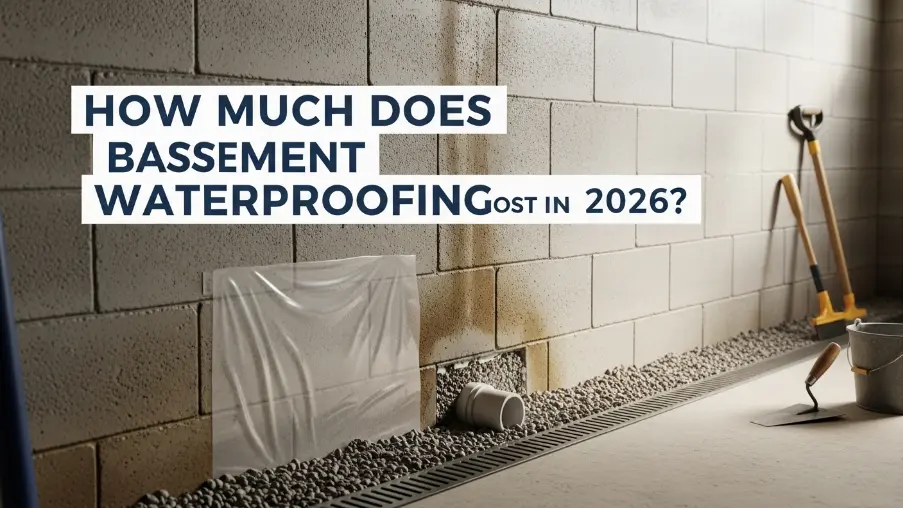
Basement waterproofing costs $70 to $180 per linear foot for interior systems, and $100 to $350 for exterior. Most homeowners pay $7,000 to $14,000 for a full project in 2026.
Several factors decide where your project lands in that range. The age of your home, the soil against the foundation, and the severity of the water each shape the figure. With heavier storms each year, a minor leak rarely stays minor.
Read on for a full breakdown of interior and exterior waterproofing costs, the factors that drive your quote, and the rebates that lower it.
How Much Does Basement Waterproofing Cost?
In 2026, interior basement waterproofing in Toronto runs $70 to $180 per linear foot. Exterior waterproofing costs more, landing between $100 and $350 per linear foot. The gap comes down to digging, and the reason becomes clear further down.
The total matters more than the rate, though. Most GTA homes carry 100 to 150 linear feet of foundation wall. Once you do the math, projects usually settle in these ranges.
| Method | Per linear foot | Typical project |
| Interior waterproofing | $70 – $180 | $4,000 – $10,000 |
| Exterior waterproofing | $100 – $350+ | $15,000 – $35,000 |
| Foundation crack repair | per crack | $600 – $1,500 |
| Sump pump installation | per unit | $1,200 – $2,500 |
| Weeping tile system | $60 – $120 | by length |
A complete basement waterproofing project typically costs between $7,000 and $14,000 for most homes.
Many contractors price major projects this way because the different components work together. It’s similar to a full basement renovation, where the entire project is often quoted as one package rather than charging for each task separately.
Read More: Why More Homeowners In Markham Are Choosing To Renovate Instead Of Move
What’s Included in Your Quote
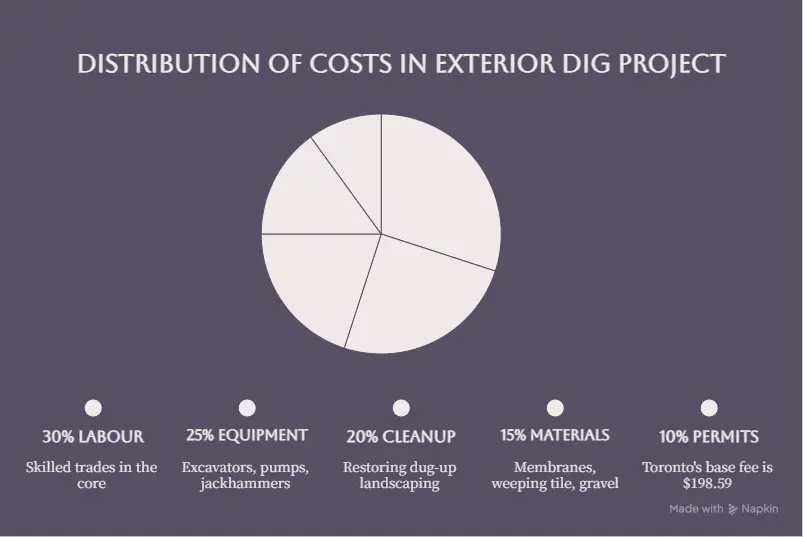
Knowing what you pay for makes comparing quotes far easier. A vague one-line estimate hides too much. So here is every piece that makes up the bill.
| Cost item | What you pay | Why it matters |
| Inspection | Usually free | Reputable GTA crews assess at no charge |
| Labour | Bulk of the bill | Skilled trades cost more in the core |
| Materials | Membranes, weeping tile, gravel | Cheap materials fail faster |
| Equipment | Excavators, pumps, jackhammers | High water table adds $2,000 – $6,000 |
| Permits | $200 – $800 | Toronto’s base fee is $198.59 |
| Cleanup | $2,000 – $8,000 | Restoring dug-up landscaping |
Labour and equipment swallow most of the money. That is exactly why an exterior dig costs so much more than an interior fix. More digging means more hours, more machines, and more cleanup.
A simple tip helps here: always ask for an itemized breakdown. A contractor with nothing to hide will provide one gladly. The same transparency should apply to any whole home renovation quote you receive.
Basement Waterproofing Cost by Method
Your chosen method shapes the price more than any other factor. So it helps to walk through both, then match one to your home.
i) Interior Waterproofing Cost
| Interior option | Cost |
| Sealants and waterproof coatings | $1 – $8 / sq ft |
| Crack injection repairs | $600 – $1,500 / crack |
| Interior drain tile systems | $60 – $120 / linear ft |
| Sump pump installation | $1,200 – $2,500 |
| Vapor barrier installation | $1,500 – $3,000 |
| Interior French drain systems | $60 – $120 / linear ft |
Sealants and waterproof coatings
Waterproof paint runs $1 to $8 per square foot. It is the cheapest option, so it tempts a lot of homeowners. But it only resists light moisture, and it wears off in three to five years. Think of it as a bandage, not a cure.
Crack injection repairs
A single crack costs $600 to $1,500 to seal. Polyurethane fills the gap and stops leaks. Epoxy, by contrast, welds the concrete back to full strength. With several cracks, most contractors drop the per-crack price for volume.
Interior drain tile systems
This perimeter system costs $60 to $120 per linear foot. First the crew jackhammers a channel around your floor. Then they lay perforated weeping tile in gravel and route the water to a sump pit. Expect three to five dusty days of work. New flooring and tiling goes back down once the system is sealed and dry.
Sump pump installation
A basic sump pump install runs $1,200 to $2,500. The pump sits in a pit and ejects collected water away from your home. A battery backup adds $800 to $1,500, and it earns that price. When heavy storms knock out the power, the backup keeps pumping.
Vapor barrier installation
Full coverage costs $1,500 to $3,000. The barrier blocks moisture from wicking through your concrete walls. Its limit is worth remembering, though. It controls dampness, but it will not stop water from pushing through a crack.
Interior French drain systems
This is simply another name for the perimeter drain tile above. One honest warning applies here. It is the most oversold product in the trade. Some homeowners pay $6,000 for a drainage system when $1,000 of crack injection would have solved it. So a proper diagnosis should always come first.
Read More: Garden Suite Cost: The Complete 2026 Budget Guide
ii) Exterior Waterproofing Cost
| Exterior option | Cost |
| Excavation | $100 – $350+ / linear ft (base) |
| Exterior waterproof membranes | included in base rate |
| Exterior drainage systems | included in base rate |
| Foundation drain installation | part rebate-covered |
| Exterior crack repair | $50 – $650 / crack |
Excavation
This single step drives most of the cost. Crews dig down to the footing, usually 5 to 8 feet in Ontario. Older Toronto homes, however, often reach 9 or 10 feet. Each extra foot of depth adds $20 to $50 per linear foot.
Exterior waterproof membranes
Once the wall is exposed, the crew coats it with a multi-layer rubberized membrane. This seal forms the real barrier against groundwater.
Exterior drainage systems
Next, fresh weeping tile goes in at the base, packed in gravel. From there, it carries water away from your foundation for good. Done right, this system can outlast everything else in the project.
Foundation drain installation
This connects your drainage to the sump or storm sewer. Helpfully, the Toronto rebate covers part of the severance cost.
Exterior crack repair
While the wall is open, sealing cracks costs $50 to $650 each. Because the fix happens from the outside, the repair holds permanently.
Whole-home cost depends heavily on size, so here is how it scales:
- Small bungalow (100 ft): $10,000 – $15,000
- Average detached (140 ft): $15,000 – $25,000
- Large two-storey (180 ft): $20,000 – $35,000
The pattern is worth noticing, though. Bigger jobs often cost less per foot, thanks to economies of scale. So a large home is not always the budget nightmare it first appears. Homeowners adding square footage through a home addition often handle exterior waterproofing in the same dig.
Read More: Home Addition Prices: What to Budget in 2026
Major Factors Affecting Basement Waterproofing Cost
Basement size
Contractors price the work per linear foot of foundation wall. A small bungalow may sit near $4,000, while a sprawling home can pass $20,000. In short, your perimeter sets the baseline before any other variable applies.
Foundation type
Poured concrete accepts crack injection cleanly, so targeted repairs stay affordable at $600 to $1,500. Hollow block walls cannot hold that material, however. Because of this, they usually call for exterior work that begins around $15,000.
Soil conditions around the home
Heavy clay sits beneath many properties in this region. Since clay packs tightly and traps water, crews need 25% to 50% more effort to excavate it than sand. That single condition can add thousands to a dig.
Accessibility of the foundation
Consider a semi-detached home with a three-foot side yard. No excavator fits through that gap, so the crew must dig by hand. That slower, manual labour adds 30% to 50% to an exterior project.
Age of the property
Many homes here predate 1960, and their age tends to show below grade. Older builds often conceal failed drain tile, settling cracks, and outdated plumbing, which can add $200 to $600 in extra work. The same surprises appear regularly in older home renovation projects.
Lot grading and drainage
Sometimes the real problem starts outside the wall. When the yard slopes toward the house or downspouts dump water at the foundation, moisture pools where it should not. Regrading the lot to redirect that flow runs $900 to $3,000.
Existing drainage problems
Clogged or failed weeping tile rarely recovers with a simple cleaning. More often, it requires full replacement at $60 to $120 per linear foot. As you would expect, that scope expands both the timeline and the final invoice.
Problem type
Light spring dampness usually clears up with a modest fix, often under $1,500. A flooding basement, by contrast, demands a complete system costing $10,000 or more. Ultimately, the severity of your water issue decides the size of the job.
| Problem severity | What it looks like | Typical cost |
| Minor dampness | Musty smell, light wall moisture | Under $1,500 |
| Active seepage | Damp patches, water after heavy rain | $3,000 – $8,000 |
| Recurring leaks | Cracks leaking, pooling at the floor | $8,000 – $15,000 |
| Full flooding | Standing water, sewer backup | $15,000+ |
Read More: How Much Does A Home Renovation Cost In Burlington?
Is Basement Waterproofing Worth the Cost?
Yes, basement waterproofing is worth the cost for nearly every GTA home. A few thousand dollars now prevents tens of thousands in water damage later, and the protection lasts for decades.
An unaddressed water-damage claim in Ontario averages $43,000, and insurance rarely covers all of it. Set that against a $1,200 crack repair or a $5,000 drainage system, and the fix looks tiny. Better still, the value compounds over time.
Waterproofing also does more than stop a flood. It protects your resale value, blocks mould before it takes hold, and turns a damp, unused basement into real living space.
That payoff grows when the dry, finished room later becomes a rental property renovation that earns steady income.
How to Save Money on Basement Waterproofing
Waterproofing will never be cheap, but smart planning trims the bill without cutting corners. These seven moves save the most.
- Claim the Toronto rebate. The city now refunds up to $6,650 per property for backwater valves, sump pumps, and battery backups
- Check your regional program too. Halton, Hamilton, and Peel all offer their own flood-prevention rebates worth $1,500 to $2,725.
- Get a real diagnosis first. A proper inspection finds the true source, so you avoid paying for a full system when one crack is the culprit.
- Match the method to the problem. Interior systems handle ordinary seepage cheaply, while the costly exterior dig suits serious, recurring leaks.
- Bundle the work. Pairing waterproofing with a renovation puts one crew on the job, which beats coordinating three separate trades.
- Seal minor cracks early. A hairline crack costs little to inject now, yet ignoring it invites a flood and mould later.
- Time the job wisely. Booking outside peak spring demand often lowers labour rates and shortens your wait for a crew.
Read More: Top Home Renovation Trends in Richmond Hill for 2026
Get Your Free GTA Basement Assessment
Basement waterproofing cost depends on your foundation, soil, and the severity of the water, so no single number fits every home. Still, a small fix today beats a $43,000 flood tomorrow.
Book an inspection before the spring thaw, and claim every rebate you qualify for. Ready to protect your basement? Call Renovation RM at 416-879-2717 for a free, no-pressure assessment.
Frequently Asked Questions
How long does basement waterproofing take?
Interior systems usually wrap up in one to three days. Exterior excavation runs longer, often three to seven days, since the dig and backfill add time.
Can I waterproof my basement myself?
A homeowner can seal a hairline crack with DIY sealant. But active leaks, hydrostatic pressure, or a high water table need a pro, since a botched fix often costs more to redo.
Does home insurance cover basement waterproofing?
No. Insurers treat waterproofing as preventive maintenance, so the cost falls on you. They may, however, deny flood claims if you ignored a known problem.
What is the best time of year to waterproof a basement?
Late summer and fall are ideal, since the ground is dry and crews are less booked. Interior work, though, can proceed year-round regardless of frost.
Do leaky window wells need fixing during waterproofing?
Often yes. Poorly drained window wells let water pool against the glass, so adding proper drainage protects the basement and stops a common leak point.