
A garden suite in Ontario costs $200,000 to $550,000 all-in. Permits, soft costs, and utility servicing add $25,000 to $70,000 before construction even starts.
That gap between what contractors quote and what projects actually cost is where most homeowners get blindsided. You’ve likely already searched online, seen a number like “$300 per square foot,” and walked away more confused than before.
Rental demand across this province keeps rising, and more families are using backyard space to generate income, support aging parents, or help adult children who can’t afford to move out.
A garden suite can do all of that – but only when the budget going in matches the reality on the ground. Read on to get a complete, honest breakdown before you speak to a single contractor.
How Much Does It Cost to Build a Garden Suite?
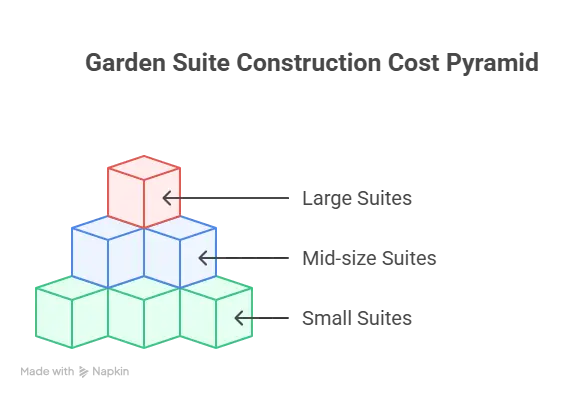
Garden suite construction costs in Ontario range from $200,000 to $550,000 all-in for a 400 to 1,100 sq ft build in 2026. The total shifts based on size, finishes, site conditions, and your municipality’s requirements.
| Suite Size | All-In Cost Range | Cost Per Sq Ft |
| Small (400-500 sq ft) | $200,000 – $275,000 | $350-$500/sq ft |
| Mid-size (500-650 sq ft) | $275,000 – $350,000 | $300-$450/sq ft |
| Large (700-1,100 sq ft) | $350,000 – $550,000+ | $280-$400/sq ft |
Garden Suite Cost: What You’re Actually Paying For
Most builders quote construction only. However, a real garden suite budget covers eight distinct cost categories. Skip any one of them, and you’ll be scrambling for money mid-build.
Soft Costs
Soft costs are everything before a shovel hits the ground – and they add up faster than most people expect. Architectural drawings run $7,500 to $20,000. Structural and mechanical engineering adds $2,000 to $6,000. A survey and site plan costs $1,500 to $4,000.
Fortunately, the City of Toronto offers free pre-approved “Made in Toronto” garden suite plans. Using them saves $10,000 to $20,000 on design fees. Total realistic soft costs: $25,000 to $70,000 before construction begins.
Read More: Bathroom Renovation Cost In Etobicoke: Complete 2026 Guide
Permit and Approval Fees
Toronto’s building permit costs $644. That figure appears everywhere as the total permit cost – it isn’t. In addition to the permit, you may also need to pay for a ZALC zoning pre-check ($214.79), zoning review fees ($2,000–$6,000), and, if your project doesn’t fully meet zoning rules, a Committee of Adjustment application ($2,228–$5,011).
Utility Servicing Costs
Connecting water, sewer, and hydro to the suite runs $15,000 to $40,000 or more. Many older properties across Ontario need a panel upgrade from 100-amp to 200-amp service just to support two kitchens running at the same time.
In Vaughan, separate water and electrical meters are required specifically for the garden suite, pushing this line higher than most other municipalities. This is the most consistently underquoted cost on any contractor estimate.
Homeowners working with older properties benefit from older home renovation expertise before finalizing drawings, since utility issues found early cost far less than those found mid-build.
Site-Specific Conditions
Here’s what most people don’t realize: your neighbour’s build cost tells you almost nothing about yours. Tight side yard access raises delivery costs. Heritage-designated neighbourhoods require a Heritage Permit, adding 4-6 weeks and extra fees. Lots near ravines or creek corridors need additional flood compliance review.
Foundation and Site Preparation
Slab-on-grade runs $8,000 to $15,000 and suits most well-drained lots. Helical piles handle difficult soil at a higher cost. A full-poured concrete foundation costs the most upfront but adds long-term durability and below-grade storage. Site clearing, grading, and access path work add another $5,000 to $15,000.
Read More: Home Addition Prices: What to Budget in 2026
Construction and Hard Costs
The base shell – framing, roofing, windows, and rough-in mechanical, electrical, and plumbing – runs $400 to $600 per square foot. Interior finishes add $60 to $120 per square foot on top.
Quality kitchen renovation work inside a garden suite runs $8,000 to $25,000, depending on finish level. A standard bathroom renovation costs $8,000 to $15,000.
Professional painting and decorating services bring the finished look that holds up through years of tenant use.
Contingency Buffer
Always add 10-15% on top. Change orders mid-construction are the single biggest budget overrun on GTA builds – no exceptions. Build the buffer in before the project starts, not after a surprise surfaces on site.
Energy-Efficient Upgrades
These are optional, but planning for them early costs far less than retrofitting later. High-efficiency insulation adds $3,000 to $6,000. Triple-glazed windows cost $4,000 to $8,000 more. Solar panels run $10,000 to $18,000.
Adding smart home features – smart locks, energy monitoring, EV-ready electrical – during the initial build costs a fraction of what retrofitting does afterward. Tenants increasingly look for these features, and properties offering them consistently command stronger rents.
Factors That Affect Garden Suite Costs in Toronto
Size and Complexity of the Project
Size is the biggest single cost driver. Every additional square foot adds $250 to $350 in construction cost. Furthermore, a two-bedroom layout costs more than a studio not just in size, but because of extra plumbing runs, partition walls, and finished surfaces throughout.
Foundation Type
Slab-on-grade keeps upfront costs down on well-drained lots. A full poured foundation adds 15-20% to foundation costs but delivers stronger long-term value. The right choice depends on your soil conditions and what you’re planning to do with the property over the next 20 years.
Type of Materials and Finishes
Builder-grade finishes keep costs at the lower end. Premium cabinetry, hardwood floors, and custom tile can add $30,000 to $60,000 to the total.
For rental properties, mid-range materials are the smarter investment. Quality flooring and tiling, and well-finished living and bedroom spaces, reduce maintenance costs and directly affect how long tenants stay.
Utilities and Infrastructure
The farther the suite sits from your main service connections, the higher the cost. Older properties with undersized pipes or original wiring need full utility upgrades before the garden suite can connect.
Two-Storey vs. One-Storey Build
A two-storey build costs more upfront. However, it’s cheaper per square foot because fixed costs are spread across more livable area. In Toronto, a two-storey garden suite can reach 1,076 sq ft under the bylaw maximum and commands meaningfully higher monthly rent.
Zoning Compliance and Permit Complexity
Most GTA lots qualify as-of-right under Ontario Regulation 462/24 and Toronto Zoning By-law 849-2025. Heritage districts, irregular lots, and tree protection zones can push a project into variance territory – adding $2,228 to $5,011 in fees plus 3-6 months to the timeline.
Read More: How Long Does a Home Renovation Take? 2026 Guide
Hidden Costs to Build a Garden Suite You May Need to Consider
Tree Protection Requirements
Toronto’s Private Tree Bylaw protects any tree with a trunk 30cm or more in diameter. Touching a protected root zone requires an arborist report at $1,500 to $3,500. Tree removal fines reach $100,000 per tree. This is one of the most common budget surprises on mature residential lots across the GTA.
Soil and Site Conditions
Clay-heavy or poorly drained soil pushes foundation costs up by $5,000 to $20,000. Discover this before design starts – not halfway through the excavation.
Zoning Variance Need
Vaughan caps garden suites at 80 sq metres (861 sq ft) – the smallest maximum in the GTA – and requires a separate parking space. Markham allows up to 100 sq metres (1,076 sq ft) but adds 6-8 weeks for site plan approval on suites over 75 sq metres. Always confirm your city’s rules before commissioning drawings.
Seasonal Labour Demand
GTA trades run at peak capacity from May through September. A fall or winter construction start can save 5-10% on labour, meaningful on a $300,000+ project.
Builder Experience
Inexperienced contractors miss zoning requirements mid-build. Change orders from planning errors cost far more than any savings from a low initial quote. The gap between the cheapest and most accurate estimate is rarely the build cost – it’s what the cheaper number left out.
How to Finance Your Garden Suite
A $300,000 garden suite may sound expensive, but you don’t necessarily need to fund the entire project from your savings. These are some of the financing options GTA homeowners are commonly using in 2026:
- CMHC-Insured Refinance for Secondary Suites – If you live in the home, you may be able to refinance and borrow up to 90% of your home’s value (LTV). Introduced in January 2025, this has become one of the strongest financing options available for Canadian homeowners adding a secondary suite.
- HELOC (Home Equity Line of Credit) – One of the most popular options across the GTA. Many lenders allow homeowners to borrow up to 80% of their available home equity, which can often cover a large portion or even all of the garden suite construction costs.
- Construction Loan – A short-term financing option designed for building projects. Funds are released in stages as construction moves forward and are typically converted into a regular mortgage after the garden suite is completed.
- Development Charge Deferral – For qualifying secondary suites in Toronto, applicable development charges can be deferred interest-free for up to 20 years. Since these charges can add $20,000–$40,000 to a project, this can provide meaningful long-term cash-flow flexibility.
Is a Garden Suite Worth It? ROI and Rental Income
For many homeowners, yes! A garden suite can be a strong investment if your goal is rental income and long-term property value.
Across the GTA, one-bedroom garden suites typically rent for $2,500–$3,300 per month, while larger two-bedroom units can reach up to $4,800 monthly in desirable areas. A $300,000 build earning around $2,800 per month delivers an estimated 11.2% gross annual return, with a rough 9–11 year payback period.
If you want a lower-cost option, a legal basement suite usually costs $60,000–$120,000 to build but generates lower rental income. For investment-focused projects, thoughtful layouts and durable finishes can make a big difference in long-term returns.
How to Save Money on Your Garden Suite Build
You don’t always need to cut size or quality to reduce costs. A few smart decisions can make a noticeable difference:
- Use Toronto’s pre-approved plans – These can save $10,000–$20,000 in architectural fees while still meeting permit requirements.
- Choose a slab-on-grade foundation – For many standard GTA lots, this can reduce upfront costs by $8,000–$20,000 compared to a full poured foundation.
- Install utilities at the same time – Coordinating water, sewer, and electrical work avoids repeat excavation costs.
- Build outside peak season – Starting in fall or winter may reduce labour costs when contractor demand is lower.
- Work with a design-build team – Keeping design and construction under one team can reduce delays and coordination costs.
- Get three detailed quotes – Compare utility servicing separately, since pricing often varies most in that category.
- Bundle projects together – If your main house also needs updates, completing both projects at once through a whole-home renovation can reduce overall construction costs.
Ready to Build Your Garden Suite?
The right builder structures the real garden suite cost before the first drawing is commissioned – catching zoning issues early, itemizing every line, and keeping the project on track when permits take longer than expected. That kind of planning at the start is what separates the builds that finish on budget from those that don’t.
RM Renovation has delivered custom homes and home additions across Toronto, Etobicoke, Mississauga, Vaughan, and Oakville for over 20 years. Every project starts with a free site consultation and a fully itemized written quote – no guesswork, no surprises.
[Book Your Free Consultation Today]
FAQs
Why do smaller suites cost more per square foot?
Smaller garden suites often cost more per square foot because major costs such as foundations, utilities, kitchens, bathrooms, permits, and servicing stay relatively similar regardless of size. Since those fixed costs are spread across fewer square feet, the average cost per square foot becomes higher.
What are the City’s free pre-approved plans?
Toronto’s “Made in Toronto” program offers pre-approved garden suite designs that already meet many permit requirements. Using these plans can reduce design time and help lower architectural costs compared to creating a fully custom design.
Why are development charges waived?
Development charge exemptions for garden suites and qualifying secondary units are intended to encourage more housing supply. These policies were expanded through housing initiatives, helping homeowners build additional housing with lower upfront cost
Written by Robert Milchevich, RM Renovation.