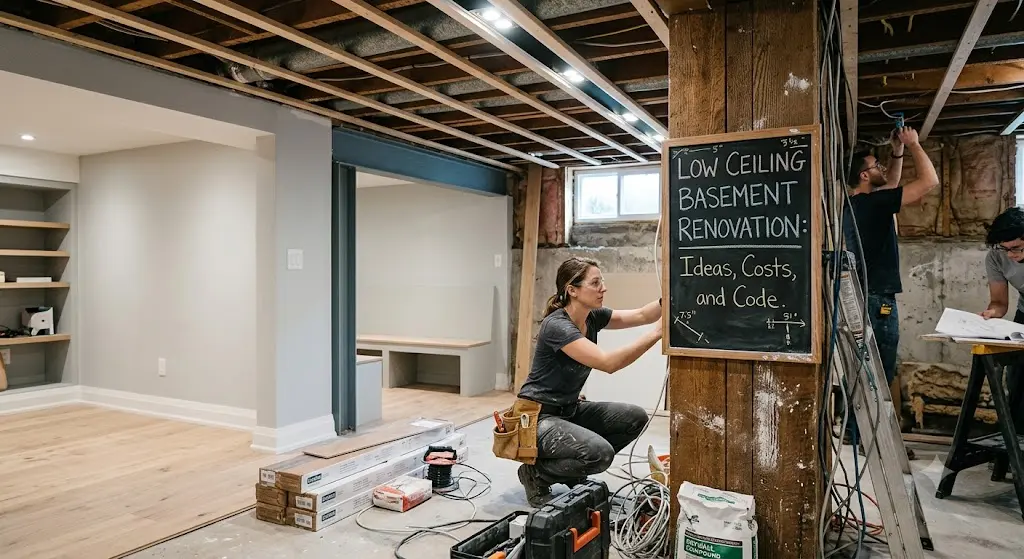
In 2026, basement renovation costs run from $35,000 to $140,000+, depending on scope, size, and finish level. A basic finish with framing, drywall, flooring, and pot lights starts at $35,000. Once you add a bathroom, your budget moves to $55,000 to $80,000.
If your goal is a legal basement suite with a separate entrance and full kitchen, plan for $90,000 and above.
Your basement sits under one of the most expensive housing markets in Canada. Every unfinished square foot below your feet costs you money without returning anything. Finishing what you already own costs far less than buying up in this market. Read on to find out exactly what every basement renovation cost factor means for your project and how to budget the right way.
How Much Does a Basement Renovation Cost?
In 2026, the basement renovation cost in Toronto runs from $35,000 to $140,000+. Most GTA homeowners spend $55,000–$80,000 for a mid-range finish. Legal basement suites start at $90,000.
Basic Basement Renovation Cost
For a clean, functional finish, you should plan a budget in the range of $35,000 to $55,000. At this level, your basement transformation focuses on the essentials that truly make the space livable and comfortable.
You’ll typically get framing, proper insulation, drywall installation, pot lights for modern lighting, durable LVP flooring, and a full interior paint finish.
Mid-Range Basement Renovation Cost
For homeowners who want a bathroom included, the realistic budget sits between $55,000 and $80,000. You get a 3-piece bathroom, upgraded LVP flooring, pot lights, and properly defined rooms.
High-End Basement Renovation Cost
For a legal suite or a high-end basement build, you should plan a budget in the range of $80,000 to $140,000+.
At this level, your project goes far beyond a simple renovation. You’re getting a fully functional second living space that typically includes a complete kitchen, a separate entrance for privacy, and independence.
If you want your Toronto basement to be fully code-compliant, our basement renovation team handles GTA permits and inspections end-to-end.
Basement Remodel Costs Per Square Foot
In Toronto, basement renovation costs typically range from about $35 to $400+ per square foot, depending on the level of finish you choose.
Your design goals, materials, and complexity of the build ultimately determine where your project falls within that range.
| Finish Level | Cost Per Sq Ft | Typical Total (1,000 sq ft) |
| Basic | $35 – $55 | $35,000 – $55,000 |
| Mid-Range | $55 – $75 | $55,000 – $75,000 |
| High-End / Legal Suite | $90 – $140 | $90,000 – $140,000 |
| Legal Suite + Waterproofing | $95 – $200+ | $95,000 – $200,000+ |
| Luxury / Custom | $150 – $400+ | $150,000 – $400,000+ |
Read More: What’s the Cost of Full Home Renovation in Ontario?
Basement Renovation Cost by Project Type
Here’s what Toronto homeowners actually pay for each project type in 2026.
Cost to Finish an Unfinished Basement
Most GTA homes carry 800–1,200 sq ft of unfinished basement space. A standard finish runs $35,000 to $55,000. Your project covers metal stud framing, spray foam insulation, drywall, vapour barrier, pot lights, and LVP flooring. A City of Toronto building permit covers the full scope.
Basement Apartment Conversion Cost
The basement apartment conversion cost in Toronto runs $90,000 to $140,000. Under Ontario’s Provincial Regulation 462/24, your build requires Type X fire-rated drywall, interconnected smoke and CO alarms, and a minimum 6’5″ ceiling height.
A separate ESA electrical permit covers all wiring. Your completed kitchen renovation, separate entrance, and independent HVAC bring rental income to $2,300–$3,500/month.
In-Law Suite Basement Renovation Cost
Across Brampton, Scarborough, and Mississauga, in-law suites lead all basement renovation requests. The in-law suite basement renovation cost runs $60,000 to $100,000+.
Your suite covers a private bedroom with an egress window, a 3-piece bathroom, a kitchenette, and a separate entrance. If your ceiling sits below 6’5″, budget for underpinning separately.
Home Theatre Basement Cost
A dedicated home theatre runs $50,000 to $100,000+. Your project covers resilient channel soundproofing, mass-loaded vinyl, specialty pot lights, and a dedicated ESA-approved circuit for all AV equipment. Custom builds with premium seating and wet bars push well beyond $120,000.
Basement Rec Room or Home Gym Cost
A basement rec room or home gym runs $35,000 to $60,000 across Toronto. Your project covers metal stud framing, drywall, pot lights, and LVP flooring.
For a home gym, interlocking rubber flooring runs $3–$8/sq ft. No plumbing rough-in keeps your budget at the lower end.
How Much Does It Cost to Add Each Feature to Your Basement?
Cost to Add a Bathroom to a Basement
In Canada, a basement bathroom usually costs $15,000–$25,000 for a basic setup and $20,000–$35,000 for a 4-piece. Most of the cost comes from plumbing work, especially if there’s no existing rough-in.
Read More: Top 20 Bathroom Renovation Trends to Watch for 2026
Cost to Add a Basement Bedroom
To add a basement bedroom, it will typically costs $4,700–$14,300. The biggest expenses are the egress window ($2,600–$5,300), window well ($3,000–$8,000), and closet build ($1,100–$3,000). The final price depends on how much structural work your basement needs.
Cost to Add a Separate Entrance
In the Greater Toronto Area, a separate entrance usually ranges from $2,000–$30,000. A full walkout with excavation and stairs sits at the top end, while a simple door installation is much lower. Any modification requires permits from the City of Toronto.
Cost to Add a Wet Bar
A basic wet bar costs $5,000–$10,000, while a custom setup with stone counters and cabinetry can reach $10,000–$25,000+. If plumbing isn’t already nearby, expect an extra $2,500–$6,000 for installation work.
Cost to Add a Home Theatre
A basement theatre typically costs $20,000–$60,000+, depending on equipment and design. High-end builds with full acoustics, lighting, and luxury seating can go up to $80,000–$120,000+.
Cost to Add Soundproofing
Soundproofing usually ranges from $3,000–$8,000 for basic work and $8,000–$20,000+ for full basement treatment. The price depends on how much noise control you want and the materials used.
The 7 Biggest Factors That Will Make Your Basement Cost More or Less
Your basement remodel cost in Toronto depends on far more than square footage alone. These seven factors drive the biggest price differences across GTA projects.
1. Basement Size and Layout
More square footage means more framing, drywall, flooring, and labour. A 500 sq ft basement costs far less than a 1,200 sq ft one. More rooms always mean more cost.
2. Ceiling Height and Underpinning Cost
Many older Toronto homes have ceilings under 6’5″, below the Ontario Building Code minimum. The basement underpinning cost in Toronto runs $50,000–$120,000+. Check your ceiling height before you budget anything.
3. Existing Condition of the Basement
If your GTA home predates 1980, expect moisture issues, cracked foundations, or failing weeping tiles. These conditions require waterproofing, mold remediation, or foundation work before any older home renovation begins.
4. Number of Rooms Being Added
Every wall you add means more framing, drywall, pot lights, and electrical circuits. An open-concept rec room costs far less than a bedroom, bathroom, and office combination.
5. Quality of Materials and Finishes
LVP flooring runs $4–$9/sq ft. Engineered hardwood costs $8–$15/sq ft. Luxury tile runs $5–$10/sq ft. Your finish choices account for 25–30% of your total project cost.
Plumbing and Electrical Complexity
Adding a bathroom means breaking your concrete slab, which alone costs $3,000–$8,000. GTA electricians charge $50–$100/hour. Licensed plumbers charge $90–$140/hour. Every new circuit and drain line adds cost.
Contractor Experience and Licensing
In Ontario, an online contracting service, 32% of homeowners have reported being victims of renovation scams. A licensed, WSIB-covered contractor costs more upfront. But they protect your permits, your investment, and your home’s resale value.
What are the Hidden Costs of Basement Renovations
| Hidden Cost | Cost Range |
| Mold Remediation | $3,000 – $15,000 |
| Asbestos Abatement | Specialist quote required |
| Electrical Panel Upgrade (100A → 200A) | $3,000 – $8,000 |
| Underpinning (ceiling below 6’5″) | $50,000 – $120,000+ |
| HRV/ERV System | $3,000 – $6,000 |
| Sump Pump Installation | $500 – $3,000 |
How to Budget for Your Basement Renovation the Right Way
Step 1: Measure your basement’s square footage before contacting any contractor.
Step 2: Define your main goal, such as a rec room, legal suite, in-law suite, or home theatre. Each option has a very different starting cost.
Step 3: Get at least three written quotes from licensed, WSIB-covered contractors in Toronto. Avoid verbal estimates.
Step 4: Split your budget into key areas: structure (15–20%), mechanical (20–25%), finishes (25–30%), permits (5–10%), and contingency (10–20%).
Step 5: Add a 15–20% contingency buffer. Older Toronto homes often come with hidden issues.
Step 6: Include 13% HST in your total. Most contractors quote prices before tax.
Step 7: Make sure your quote clearly covers permits, inspections, materials, payment schedule, and warranty, all in writing.
Step 8: Do not pay the full amount upfront. A reliable contractor will always use a staged payment plan.
Pro Tips to Minimize the Cost To Finish a Basement
Finding affordable basement renovation in Toronto comes down to smart planning decisions, not cutting corners on quality. Here are the tips that actually reduce your costs.
- Tip 1: Lock your layout before hiring anyone. Mid-project changes cost 2–3 times more than planning upfront.
- Tip 2: Position your bathroom near existing plumbing. This can save $3,000 to $8,000 in concrete slab work.
- Tip 3: Choose LVP over engineered hardwood. You save $4 to $6 per sq ft and get better moisture resistance below grade.
- Tip 4: Get at least three written quotes. GTA contractor prices can vary by 20 to 30 percent for the same work.
- Tip 5: Book your contractor in the fall or early winter. Lower demand often leads to better pricing.
- Tip 6: Choose a drop ceiling instead of drywall. It saves $1 to $3 per sq ft and keeps HVAC and electrical accessible.
- Tip 7: Renovate in stages if your budget is tight. Finish the rec room now, then add the bathroom later.
- Tip 8: Bundle your basement with other planned work. A full home renovation can reduce overall costs.
- Tip 9: Handle painting and decorating yourself where possible. This can save $1,000 to $3,000 in labour.
- Tip 10: Apply for the City of Toronto Basement Flooding Protection Subsidy before waterproofing. You may recover up to $3,400 on eligible work
Is a Basement Renovation Worth It? What Toronto Homeowners Are Getting
Yes, absolutely. A finished basement delivers 60–75% ROI at resale. A legal basement suite pays itself back within 3–6 years. If you are adding a rental unit, you can start earning $2,300–$3,500/month once your suite is complete.
At RM Renovation, we’ve completed over 2,700 projects across Toronto, Etobicoke, Mississauga, Brampton, and the GTA. Every project is licensed, WSIB-covered, and fully permitted.
Ready to find out what your basement renovation costs? Get your free estimate from RM Renovation, no obligation, real numbers based on your actual home.
Read More: 20 Must-know Small Bathroom Renovation Ideas for 2026
Frequently Asked Questions
How much does a basement renovation cost in Mississauga, Vaughan, and Etobicoke?
Mississauga runs $55–$85/sq ft. Vaughan runs $55–$95/sq ft. Etobicoke follows Toronto rates at $65–$95+/sq ft. Labour varies slightly, but all three material costs stay consistent.
What is the basement renovation price in Toronto for a legal secondary suite?
A fully legal secondary suite runs $90,000–$140,000. That covers a separate entrance, full kitchen, fire-rated drywall, independent HVAC, and all City of Toronto permits.
How much does it cost to finish a basement in Ontario outside the GTA?
The cost to finish a basement in Ontario outside the GTA runs $35,000–$75,000 for most projects. Labour rates drop noticeably outside Toronto, and material costs stay broadly similar.